Wobble: The Playful Typeface That Dances Off the Page
There are fonts that whisper, and then there are fonts that perform a cartwheel. If you’ve been scrolling through endless libraries of clean, safe, corporate typefaces, it might be time to inject some energy into your toolkit. We’re talking about typefaces that don’t just sit there looking pretty—they move. Finding a design asset that balances quirkiness with legibility is rare, but when you stumble upon one that feels like it has a pulse, it changes how you approach a blank canvas. This is the kind of personality we need when standard letterforms feel too rigid for the story we’re trying to tell.
Breaking the Mold of Traditional Typography
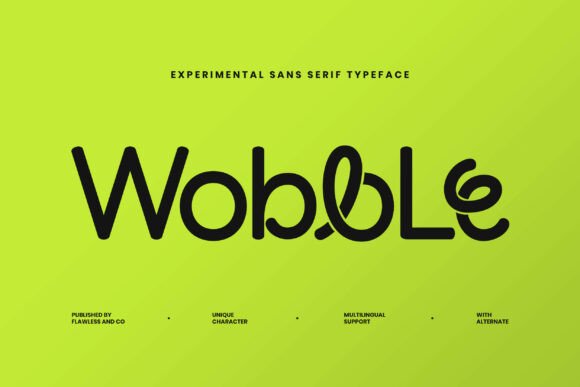
Enter Wobble, a bold experimental sans serif font that refuses to sit still. Unlike the rigid geometry of Futura or the structured clarity of Helvetica, this typeface embraces a sense of organic motion. It’s not just a font; it’s a piece of kinetic art. The defining characteristic here is the "twist." You can see it immediately in the terminals of letters like the ‘s’ or the unconventional ligatures in combinations like ‘u’ and ‘m’. These aren't errors in rendering; they are intentional design choices that give the alphabet a rhythmic, almost bouncing cadence.
For designers and creators, this offers a massive advantage: instant personality. When you use a typeface like Wobble, you bypass the need for heavy embellishments. The typography itself becomes the focal point. It creates a vibe that feels futuristic yet deeply human-centered, bridging the gap between digital precision and hand-drawn warmth. It’s the kind of design asset that signals confidence, suggesting that a brand isn't afraid to bend the rules a little.
Where Motion Meets Strategy: Real-World Applications
Knowing a font looks cool is one thing; knowing how to deploy it effectively is another. A typeface with this much character requires a strategic approach to visual communication. Because of its dynamic curves and artistic flair, Wobble shines brightest in scenarios where you need to grab attention quickly. It is a premium font designed for high-impact moments.
Consider the world of branding. If you are building a brand identity for a streetwear label, a creative agency, or a modern music festival, this font speaks the language of your audience. It feels edgy and current. In logo design, a single word set in Wobble can become a memorable icon. The twisted letterforms create a unique silhouette that stands out against competitors using standard sans serif fonts.
Beyond logos, think about packaging design. Imagine a craft coffee bag or a vibrant energy drink can. Using a creative font like this on the main label draws the eye immediately on a crowded shelf. It suggests that the product inside is just as exciting as the wrapper. Similarly, for editorial layouts—think magazine headlines or feature spreads—Wobble acts as a visual anchor. It breaks the monotony of body text and guides the reader's eye to the most important information.
The versatility extends to the digital realm as well:
- Social Media Graphics: In a fast-scrolling feed, static text often gets ignored. This font mimics the energy of video and motion, making static posts feel more alive and engaging.
- Websites and Blogs: While it might be too distinct for long-form paragraphs, it is perfect for hero sections, call-to-action buttons, and headers. It sets a modern, creative tone the moment a visitor lands on the page.
- Merchandise: From tote bags to T-shirts, expressive typography sells. It turns a simple item into a statement piece.
Mastering the Mix: Pairing and Readability
One of the biggest challenges with an expressive or artistic typeface is ensuring it doesn't compromise your message. If the text is unreadable, the design fails. Fortunately, while Wobble is experimental, it maintains the structural integrity of a functional sans serif. The key to using it successfully lies in font pairing.
Because Wobble is loud and energetic, it needs a partner that knows how to sit back and listen. You generally want to pair a display font like this with a neutral, clean sans serif or a classic serif font for your body copy. Think of it like a lead singer and a rhythm section. Let Wobble handle the headlines, the hero text, and the punchy slogans. For the detailed information—prices, descriptions, instructions—switch to a highly legible font like a geometric sans serif or a humanist serif. This contrast not only ensures readability but also creates a visual hierarchy that looks professional.
Here is a practical tip for testing your pairings: Scale the font down. How does it look at 14px? How about 10px? While display fonts are meant for larger sizes, you want to ensure they don't turn into an unreadable blob if you decide to use them as a sub-header. With Wobble, the smooth curves hold up well at medium sizes, but for fine print, always default to your secondary typeface.
Unlocking Creative Freedom with Alternate Characters
For those who love to tweak and customize, the technical features of a font matter. Wobble isn't just a single static set of letters; it comes equipped with alternates and multilingual support. This is where the "experimental" aspect truly comes to life for advanced users.
The inclusion of PUA (Private Use Areas) encoding is a massive plus for designers who use software that can be finicky with OpenType features. It means all those special decorative elements and alternate lowercase characters are accessible without needing complex programming or advanced font panel knowledge. You can easily swap out a standard ‘a’ for a more stylized version or alter the rhythm of a word by changing a specific letter.
This flexibility allows you to create custom lockups for logos or headlines that feel truly one-of-a-kind. Two different designers could use the same font for the same word, but by utilizing different alternates, they could produce two completely different results. This level of customization is essential for modern typography, where standing out is the primary goal.
Practical Considerations for Your Next Project
If you are a small business owner or a content creator, investing in a commercial font can feel like a big step. However, the right typography is an investment in your brand’s perceived value. Free fonts are everywhere, but they often come with licensing restrictions or lack the polish of a premium font. A well-crafted typeface ensures that your brand looks established and trustworthy.
Before you finalize your design, keep these practical points in mind:
- Review the License: Always check the commercial licensing. Ensure it covers your intended use, whether that’s for physical merchandise, digital products, or client work.
- Test the Context: Don’t just test the font on a white background. Place it over your brand’s photography or color palette. Does the movement of the letters clash with a busy background, or does it enhance it?
- Check the Weights: Does the font come with bold or italic variations? Having a family of weights gives you more flexibility to create emphasis without changing the typeface style.
Ultimately, choosing a font like Wobble is about embracing a mood. It’s for the projects that demand a little bit of rebellion and a lot of fun. It’s for the poster that needs to scream, the brand that wants to dance, and the designer who is tired of playing it safe. By integrating this kind of quirky, confident typography into your work, you aren't just arranging letters—you’re creating an experience. So go ahead, break the grid, and let your designs wobble a little.